 EN
EN

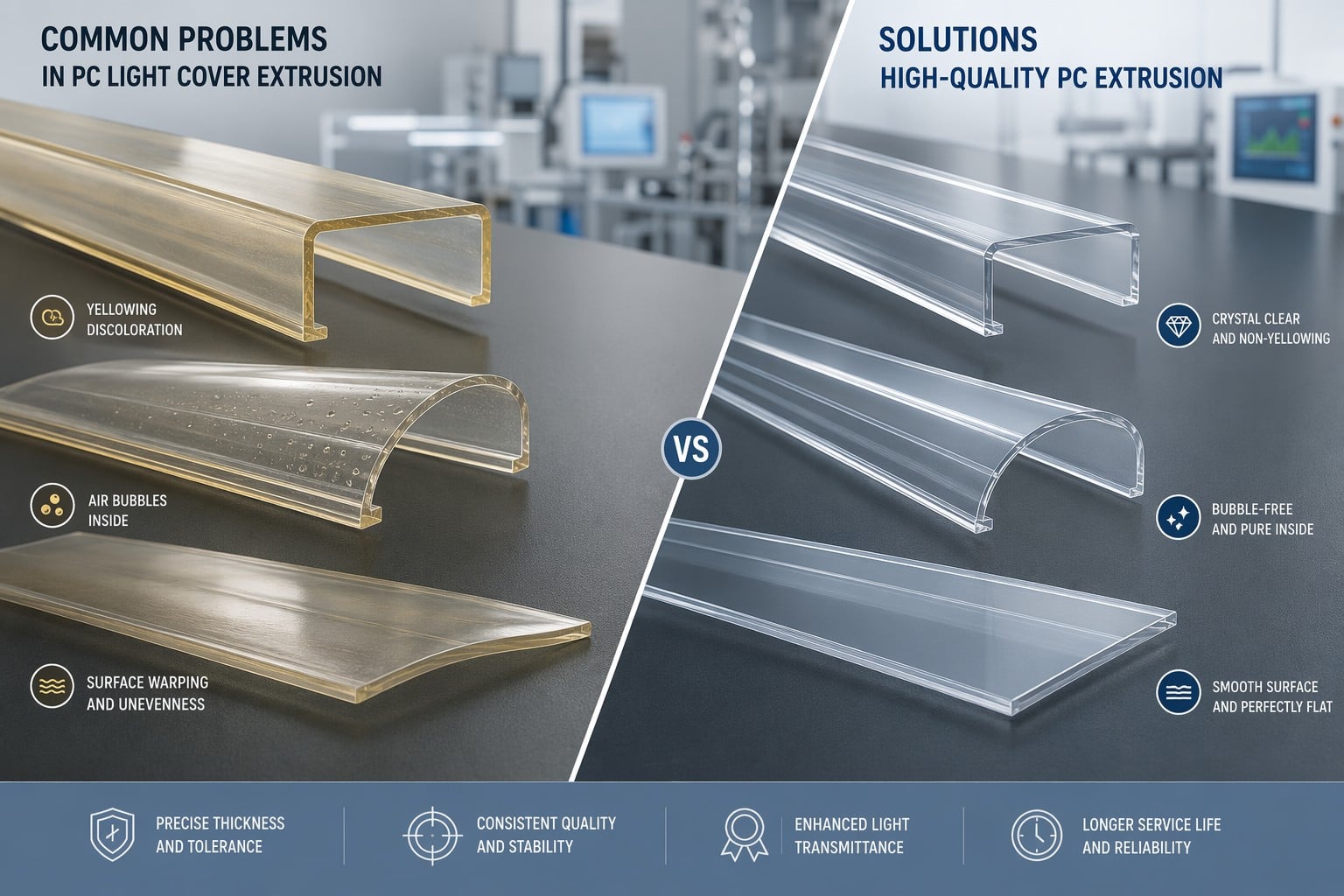
Common Problems in PC Light Cover Extrusion and Solutions
PC light covers are one of the most widely used cover types in the LED lighting industry. Thanks to PC material's excellent light transmittance, impact resistance, and temperature resistance, they have become the preferred choice for high-end lighting fixtures. However, PC light cover extrusion is no simple task—PC material has high melting temperature, high viscosity, and high cooling shrinkage, placing extremely high demands on extrusion processes, mold design, and equipment configuration.
This article breaks down the most common quality issues encountered during PC light cover extrusion, analyzes their root causes, and provides actionable solutions.
I. Surface Ripples and Flow Marks
Symptoms: Transverse or longitudinal wavy patterns on the cover surface, visible light distortion when illuminated. Primary Causes:
- Intermittent fluctuations in extruder screw conveying, unstable melt pressure
- Uneven melt compounding, pulsating output
- Unbalanced melt flow channel in the mold
- Fluctuating extruder temperature
Solutions:
- Install a melt pump: The melt pump absorbs flow and pressure fluctuations from the upstream extruder, converting them into a stable, continuous linear melt stream, eliminating ripples and flow marks at the source.
- Optimize mold flow channels: Ensure smooth flow channel design with proper proportions.
- Stabilize machine temperature: Maintain stable temperatures across all extruder zones to avoid significant fluctuations.
II. Cracking (Stress Cracking)
Symptoms: Cracks or fractures appearing in the cover after storage or during use. Primary Causes:
- Molecular chain orientation during molding, leaving significant residual internal stress
- Use of regrind material or material with excessively high flowability
- Low mold temperature, uneven cooling rates
- Use of water bath rapid cooling, causing excessive stress
Solutions:
- Increase mold temperature: Mold temperature in the range of 100-120°C is optimal for PC molding and effectively reduces internal stress
- Increase processing temperature: Processing temperature should be in the 260-330°C range; higher temperatures help molecular chain relaxation
- Adjust molding pressure appropriately: PC has high viscosity, but high pressure significantly increases internal stress; pressure should be controlled in the 800-1200 Bar range
- Optimize cooling method: Avoid water bath rapid cooling; use progressive cooling process
- Use pure virgin PC material: Avoid regrind material or material with excessively high flowability
III. Uneven Wall Thickness and Dimensional Instability
Symptoms: Significant wall thickness variation within the same batch, fluctuating dimensions. Primary Causes:
- Large shrinkage and internal stress during PC cooling
- Inconsistent output speed, unstable material supply
- Poor cooling system design, uneven cooling
Solutions:
- Install a melt pump for precise metering: The melt pump's output is proportional to its rotational speed, enabling precise control by adjusting motor speed to ensure consistent extrusion speed and uniform dimensions for every cover
- Optimize cooling system: Design uniform and rapid cooling to control dimensional accuracy and internal stress
- Use a gradual compression screw: For PC extrusion, a gradual compression screw is recommended with an L/D ratio of 1:18-24 and a compression ratio of 1:2.5
IV. Surface Black Spots and Contamination
Symptoms: Black spots, specks, or other surface defects. Primary Causes:
- PC material tends to attract dust and contaminants due to static electricity
- Contaminants in raw material or equipment
- Carbonization at weld lines
- Insufficient production environment cleanliness
Solutions:
- Strict raw material drying: Pure PC covers should be dried at 120°C; modified PC typically at 110°C for at least 4 hours, not exceeding 10 hours
- Maintain clean environment: Effectively control static electricity and prevent contaminants from entering the mold
- Apply protective film promptly: Apply protective film immediately during extrusion to prevent surface scratching and contamination
V. Surface Extrusion Lines and Drag Marks
Symptoms: Clear longitudinal lines or marks on the cover surface. Primary Causes:
- Insufficient mold precision, rough flow channel surfaces
- Poor plasticization performance of the extruder
- Unstable cooling and forming temperatures
Solutions:
- High-precision mold processing: Extrusion molds should be processed using wire EDM with mirror polishing
- Select extruders with good plasticization capability: Ensure equipment plasticization meets PC material requirements
- Stabilize cooling forming temperature: Maintain stable extruder and cooling forming temperatures
VI. Technical Summary
PC light cover extrusion is a process that demands excellence across materials, molds, equipment, and processes. In summary, the following three factors are key to ensuring PC light cover extrusion quality:
|
Key Factor |
Core Requirements |
|
Equipment Configuration |
Install melt pump to eliminate pressure pulsation; use gradual compression screw |
|
Mold Design |
Smooth flow channels, wire EDM processing, mirror polishing |
|
Process Control |
Mold temperature 100-120°C, processing temperature 260-330°C, pressure 800-1200 Bar |
Every quality issue encountered during PC light cover extrusion has a clear physical and chemical root cause. Once you identify the source and apply the right solution, most problems can be effectively resolved.
Lianzhen Plastic has been dedicated to plastic extrusion for over twenty years and has accumulated extensive process experience in PC light cover extrusion. For technical consultation or custom cover services, please feel free to contact us.