 EN
EN

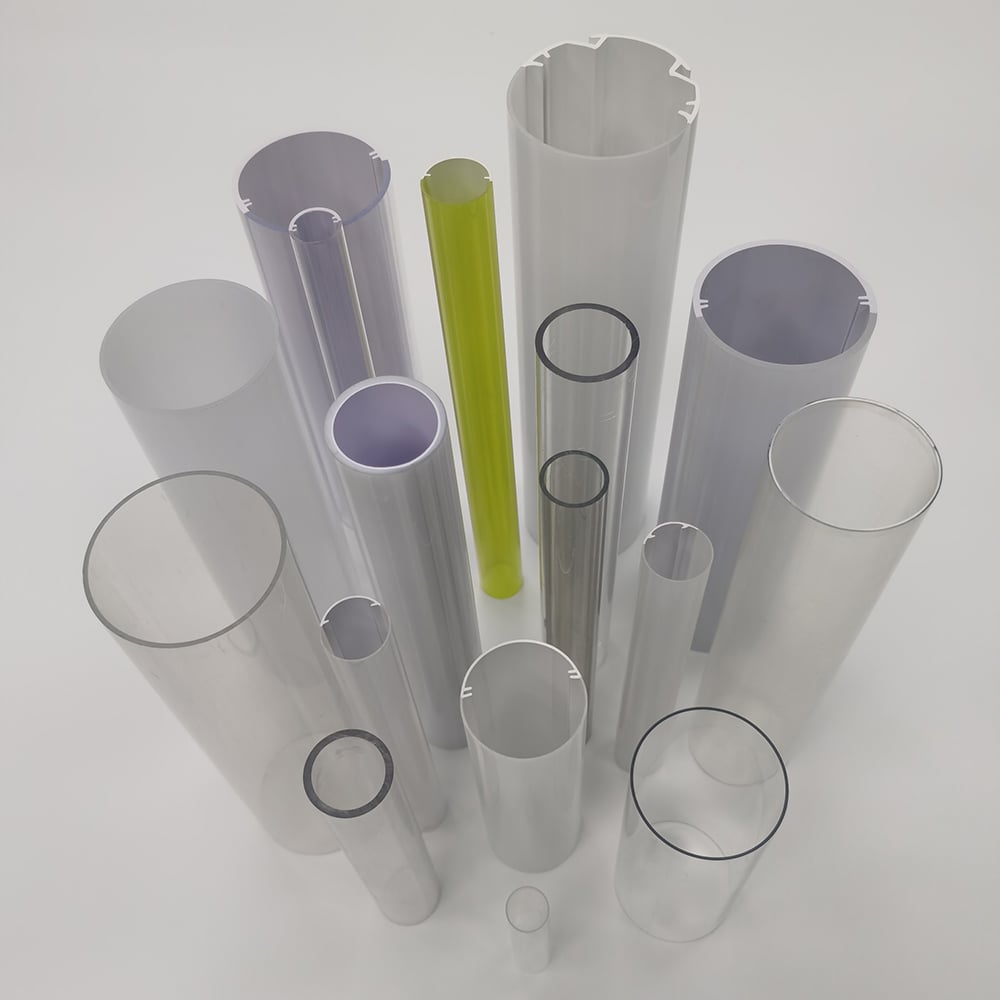
PC Plastic Tubes: A Complete Guide to Performance, Customization, and Selection
In the world of plastic extrusion, PC tubes (polycarbonate tubes) are becoming the go-to choice for industries ranging from lighting and protection to electronics and medical devices. Yet many procurement managers and engineers still face common questions during the selection process:
-
How do I choose between PC and acrylic (PMMA) tubes?
-
Why do light transmittance and impact resistance vary so much between different PC tubes?
-
Can I get custom profiles, special colors, or tight tolerances?
This article answers all of those questions — covering material properties, custom extrusion capabilities, and typical applications — so you can make an informed decision for your next project.
1. Why Choose PC for Extruded Tubes?
Compared to common materials like PVC, ABS, and PMMA (acrylic), polycarbonate offers several irreplaceable advantages:
Exceptional Impact Strength
PC is about 250 times stronger than glass and over 30 times more impact-resistant than acrylic. This makes PC tubes ideal for applications that demand both transparency and toughness — equipment guards, clear safety barriers, outdoor lamp housings. In short: crystal clear, yet virtually unbreakable.
High Light Transmission
High-quality PC resin delivers light transmittance of 88%–90%, close to that of glass. With the addition of UV stabilizers, PC tubes can withstand years of outdoor exposure without significant yellowing or loss of clarity — a critical feature for LED lamp covers, illuminated columns, and lighting fixtures.
Superior Heat Resistance
The heat deflection temperature of standard PC is around 135°C, far higher than PVC (~70°C) or general-purpose ABS (~95°C). If your product operates near heat sources or inside high-power luminaires, PC is a reliable choice.
Excellent Dimensional Stability
PC absorbs very little moisture, so its dimensions stay stable after extrusion. This makes it well-suited for secondary operations like drilling, milling, slotting, and snap-fit positioning — areas where acrylic tends to crack.
Flame Retardancy & Compliance Options
PC can be formulated to meet V0 or V2 flame retardancy standards, satisfying safety requirements for electrical and electronic applications. Food-grade and medical-grade PC are also available.
2. Common Customization Options for PC Tubes
PC tube extrusion isn't limited to standard round shapes. An experienced extrusion manufacturer can customize in the following dimensions:
Cross-Section Profiles
Round, D-shape, square, polygonal, and complex custom profiles can all be produced with dedicated tooling. Multi-channel or hollow structures are also possible for structural or cable-management uses.
Dimensional Precision
Outer diameters can range from a few millimeters to over a hundred millimeters. Wall thickness tolerances can be held to ±0.05 mm for precision structural components.
Color & Effect
Options include water-clear transparent, milky-white diffuser, and a wide range of solid colors (red, blue, amber, etc.). Light-diffusing grades are available for uniform LED illumination. Matte, pearl, or frosted finishes can also be achieved.
Secondary Processing
We can drill, slot, chamfer, and heat-bend according to your drawings. Hard-coating options are also available to improve scratch resistance.
Key Tip: If your design requires drilled holes or snap-fit features, and you need both transparency and toughness, PC is almost always a better choice than PMMA. Acrylic's advantages are lower cost and higher surface hardness — but it falls short on machinability and impact resistance.
3. PC vs. PMMA (Acrylic) Tubes: A Quick Comparison
| Comparison Point | PC Tube | PMMA (Acrylic) Tube |
|---|---|---|
| Impact Resistance | Excellent, virtually unbreakable | Poor, brittle |
| Light Transmission | 88%–90% | 92%+ |
| Heat Resistance | ~135°C | ~95°C |
| Scratch Resistance | Moderate (can be hard-coated) | Better |
| Machinability (drilling/milling) | Good, no cracking | Poor, prone to cracking |
| Cost | Higher | Lower |
| Outdoor Weatherability | Requires UV stabilizer | Naturally good |
| Flame Retardancy | V0/V2 available | Typically HB |
In a nutshell: Choose PC for impact resistance, heat tolerance, and precision machining. Choose PMMA when you need the highest clarity at a lower cost and the part won't be subjected to impact or drilling.
4. Typical Applications of PC Plastic Tubes
LED Lighting & Decorative Illumination
Lamp tube covers, light columns, diffuser tubes — taking advantage of PC's high light transmission and diffusing grades for uniform glow.
Equipment Protection & Sight Windows
Transparent machine guards, oil-level tubes, liquid sight gauges — leveraging PC's impact strength and dimensional stability.
Electronics & Electrical
Insulating sleeves, vape device tubing, sensor protection tubes — using PC's flame retardancy and heat resistance.
Display & Furniture
Connector tubes for display racks, transparent structural elements — benefiting from PC's clarity and design flexibility.
Medical & Food Equipment
Medical-grade transparent tubing, food-safe container sight windows — produced with certified medical/food-grade PC resin.
5. Frequently Asked Questions from Buyers
Q: What is the minimum order quantity? Can I get samples first?
A: Experienced extrusion manufacturers support small-batch trial orders. We provide technical consultation before tooling, and samples can be approved before mass production. Sample lead times typically start at around one week, depending on complexity.
Q: Will PC tubes turn yellow outdoors?
A: With sufficient UV stabilizer in the raw material and proper processing temperatures, PC tubes can remain clear for 5+ years of outdoor use without noticeable yellowing. For indoor applications, this is rarely a concern.
Q: Can you produce ultra-thin-wall or ultra-thick-wall tubes?
A: It depends on the outer diameter to wall thickness ratio. Our extrusion team will advise on what is feasible to maintain consistent quality without pushing beyond practical limits.
Q: Can you manufacture from a drawing or a sample?
A: Absolutely. Provide a drawing or a physical sample, specify the material, color, light transmittance, and other key requirements, and we can evaluate the tooling and process to provide a quotation.
Conclusion
With their unique combination of transparency and toughness, PC tubes are increasingly the preferred choice for industrial products. Whether you're replacing fragile acrylic or upgrading from a less heat-resistant plastic, PC deserves serious consideration.
If you're looking for a custom supplier of PC/PMMA extruded tubes, profiles, and diffusers, we're here to help. Send us your drawing or sample, and we'll support you from mold development through to mass production — all under one roof.