 EN
EN

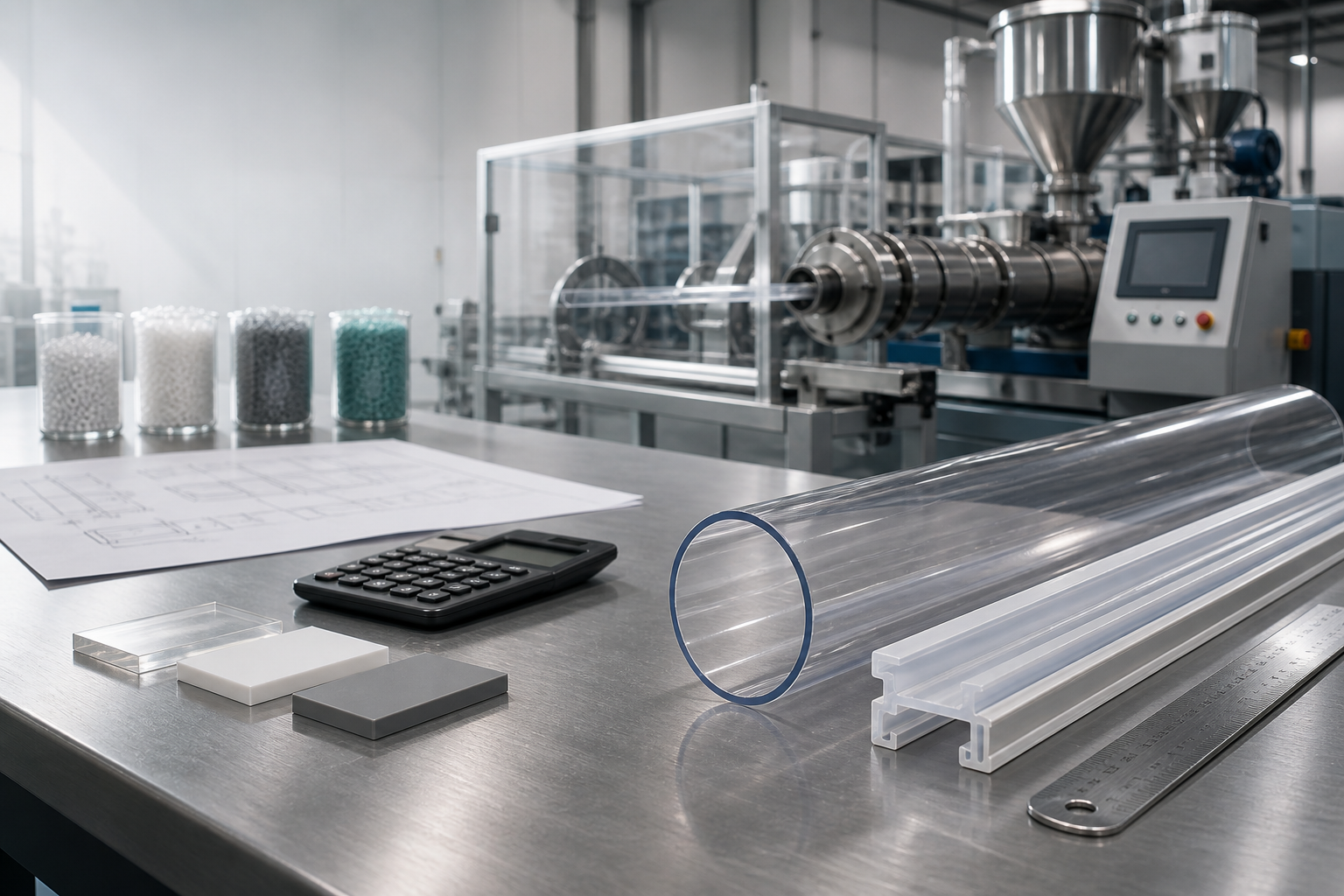
H1 2026 Plastic Extrusion Product Cost Analysis
What changed in the first half of 2026—and how should buyers evaluate the real cost of PC tubes, acrylic tubes and custom plastic profiles?
Plastic extrusion quotations are often compared by one number: the price per metre or the price per kilogram. That approach can be misleading. During the first half of 2026, resin-market movements, energy exposure, logistics uncertainty, tooling requirements and sustainability documentation all influenced the final cost of an extrusion project.
This article provides a practical framework for analysing those cost layers. It is not a universal price list. Actual quotations still depend on resin grade, profile geometry, dimensions, colour, tolerance, order quantity, tooling condition, packaging and delivery terms.
1. What the H1 2026 Market Signals Tell Us
Public market reporting shows that resin pricing remained regionally different and sensitive to feedstock, supply balance, downstream demand and logistics. For polycarbonate, Procurement Resource reported Q1 2026 and Q2 2026 regional movements rather than one globally uniform price direction.
| Reference point | Reported market information | How an extrusion buyer should interpret it |
|---|---|---|
| Polycarbonate, Q1 2026 | Procurement Resource reported an Asia average of RMB 13.84/kg for Q1, with monthly movement during the quarter. | PC budgeting should allow for grade, region and timing differences; a quarterly average is not a project quotation. |
| Polycarbonate, Q2 2026 | The same source reported China monthly averages of approximately RMB 17.05/kg in April and RMB 17.16/kg in the following month. | For transparent tubes and optical profiles, resin timing can matter, but processing quality and yield remain part of the total cost. |
| Procurement environment | Industry procurement commentary highlighted trade-policy uncertainty, sustainability requirements, feedstock exposure and supply-chain risk. | Buyers should compare landed cost, documentation and supply resilience—not only the initial material line. |
Source note: The market references above are attributed to Procurement Resource's Polycarbonate Price Trend Analysis 2026. Data is shown as a market reference and should be checked against the required grade, Incoterm, region and quotation date before commercial decisions are made.
2. The Cost Structure Behind a Custom Extrusion
The weighting of each layer changes from one project to another. A high-volume round tube may be dominated by resin and conversion efficiency, while a short run of a complex profile may be more affected by tooling, setup, sampling and inspection.
Resin and Additives
Material grade, clarity, impact performance, colour, UV package, flame-retardant package, plasticizers, stabilizers and recycled-content requirements can all change the material line.
Tooling and Calibration
Die design, mandrels, vacuum sizing, cooling fixtures and profile complexity influence the initial investment and the time required to reach stable dimensions.
Conversion and Yield
Extrusion speed, drying, heating, cooling, calibration, changeover and scrap control affect the usable output—not simply the machine running time.
Quality and Documentation
Dimensional inspection, optical checks, traceability, samples, test reports and customer-specific documentation add value and may add project cost.
Packaging and Logistics
Long profiles and tubes require protection against bending, impact, contamination and moisture. Packing density, carton length, pallet design and destination affect landed cost.
Compliance and Project Management
Material declarations, restricted-substance documentation, approval samples and engineering communication should be considered when comparing suppliers.
3. Material-by-Material Cost Considerations
Polycarbonate (PC): Performance Can Justify a Higher Material Line
PC is commonly selected when a project requires a combination of transparency, impact resistance or engineering performance. The cost question is not simply whether PC costs more than a commodity resin. It is whether the selected PC grade reduces breakage, replacement, assembly or downstream protection costs.
- Confirm whether optical clarity, impact performance, UV resistance or another property is genuinely required.
- Ask whether the quoted resin is virgin, reprocessed, modified or a specified branded grade.
- For transparent tubes and light-diffusing profiles, evaluate surface quality, bubbles, haze and yield—not only resin price.
PMMA / Acrylic: Optical Appearance and Surface Quality Drive Value
PMMA or acrylic is often selected for transparent display parts, lighting components, protective tubes and architectural elements. Its commercial value may depend heavily on appearance and consistency. A quotation that excludes the quality standard for clarity, gloss, colour or surface protection is difficult to compare fairly.
ABS: A Practical Balance for Structural and Cosmetic Profiles
ABS profiles can be attractive when rigidity, machinability, appearance and cost need to be balanced. The final cost still depends on colour, additives, wall thickness, post-processing and the level of dimensional control required.
PP and PE: Commodity Resin Does Not Mean Commodity Project
PP and PE are widely used in protective parts, tubes, guides, packaging-related components and industrial profiles. Their resin cost may be competitive, but profile thickness, cooling behaviour, tolerances, welding or assembly needs and packing efficiency can materially change the finished cost.
PVC: Formulation and Compliance Need to Be Specified
PVC extrusion cost can vary with formulation, flexibility, stabilizer system, colour, hardness and customer compliance requirements. Buyers should specify the intended application and required documentation rather than compare an unspecified PVC price with a fully documented quotation.
TPU: Specialty Performance and Process Control Affect the Quote
TPU is selected for applications that need flexibility, abrasion resistance or sealing behaviour. Drying, die design, dimensional control, hardness and surface requirements can influence conversion cost. For short runs or tight profiles, setup and process stability may be more significant than the resin line alone.
4. Why the Lowest Unit Price May Not Be the Lowest Project Cost
Procurement teams should calculate a total cost of ownership instead of selecting a supplier from a single unit-price column. The following questions help expose hidden cost:
- Does the material grade meet the real performance requirement, or will the part need reinforcement or replacement?
- Is tooling included, amortized, reused or charged separately?
- Are sampling, dimensional reports, material documents and corrective actions included?
- How much scrap is expected during startup, changeover and cutting?
- Will the packaging protect long tubes and profiles through international transport?
- Are Incoterms, freight, duties, insurance and destination handling included in the comparison?
5. A Practical H1 2026 Cost-Review Checklist
- Freeze the specification: define material family, grade requirements, colour, dimensions, tolerances, length and surface expectations.
- Separate one-time and recurring cost: list tooling, sampling and engineering work separately from the production unit price.
- Request a cost basis: ask for resin basis, Incoterm, quotation validity, packaging method and what is included.
- Review yield and quality: discuss startup waste, acceptable variation, inspection method and rejection handling.
- Compare landed cost: include packaging, freight, duties, lead-time risk and any required local handling.
- Validate compliance needs: identify whether the project requires restricted-substance declarations, recycled-content evidence or customer-specific documentation.
- Use a sample before scaling: confirm fit, appearance and processing performance before committing to a larger production plan.
Conclusion: Build a Transparent Cost Model Before You Buy
The first half of 2026 reinforced an important lesson for plastic extrusion buyers: resin market movement matters, but it does not explain the complete cost of a finished tube or profile. PC, PMMA, ABS, PP, PVC, TPU and PE projects each respond differently to material grade, tooling, yield, quality, packaging and logistics.
The most reliable quotation is therefore not always the lowest number. It is the quotation whose specification, cost basis, quality expectations and delivery conditions are clear enough to support a fair comparison.
Need a Project-Based Extrusion Cost Review?
Share your material, profile drawing, dimensions, quantity, application and destination. Our technical team can help structure the quotation around the real requirements of your PC tube, acrylic tube or custom plastic profile project.
Request a Technical Quote- 2026 Forecast for U.S. Plastics Procurement — procurement considerations around feedstock, sustainability, trade and total cost of ownership.
- Asia Plastic Resin Price Trends 2026 — discussion of resin pricing drivers, logistics and regional supply dynamics.
Editorial disclaimer: Market conditions and supplier quotations change by grade, region, date, volume and Incoterm. The figures and market observations in this article are reference information, not a binding offer or a universal price forecast.