 EN

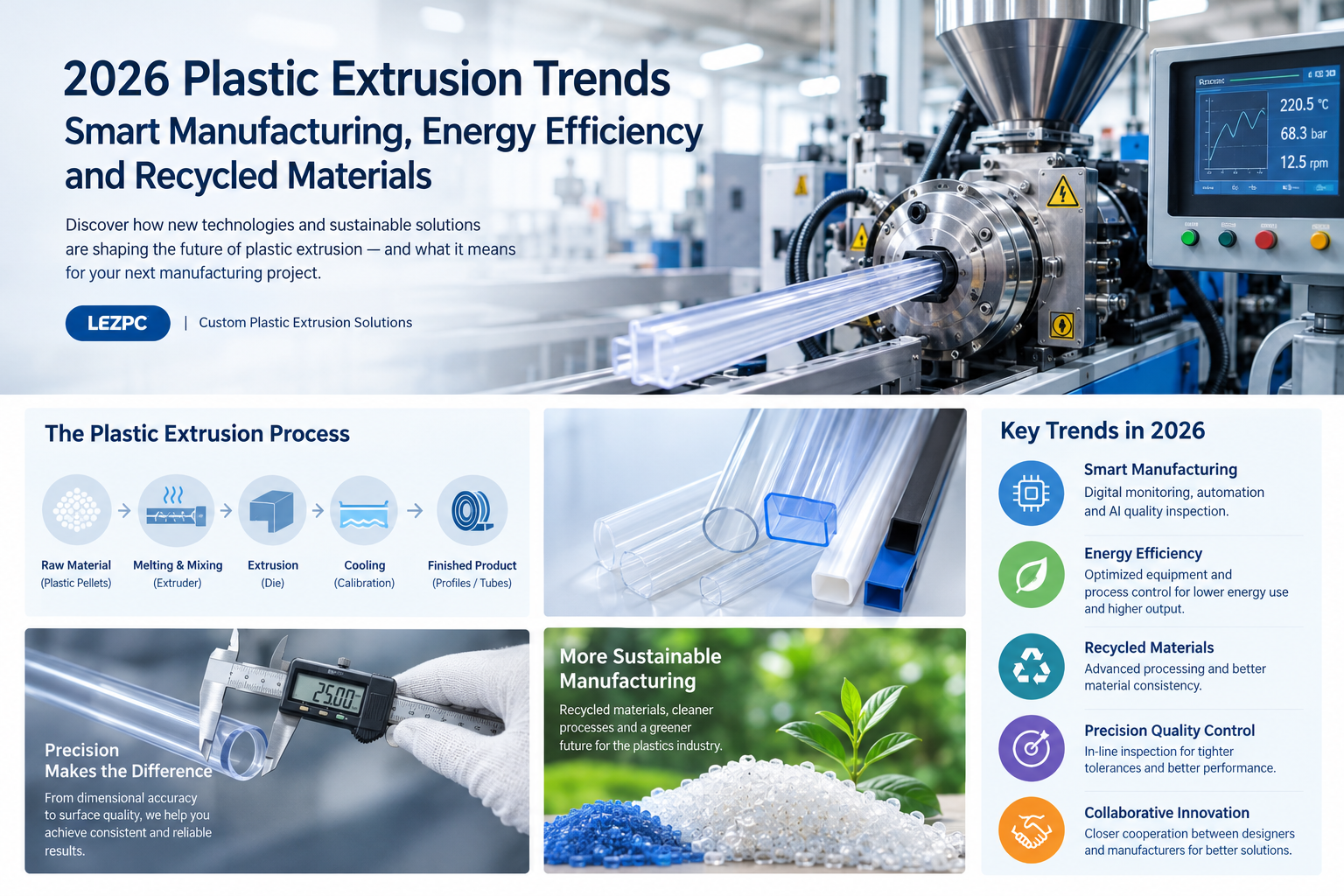
2026 Plastic Extrusion Trends: Smart Manufacturing, Energy Efficiency and Recycled Materials
Published: October 2026 | Industry Insights | LEZPC
The plastic extrusion industry is evolving as manufacturers face growing demands for consistent product quality, shorter lead times, improved production efficiency, and more responsible material use. In 2026, several developments are attracting attention across the industry, including digital process monitoring, automated quality inspection, energy-efficient extrusion, and technologies designed to process recycled plastics more reliably.
For OEM buyers, product designers, and industrial manufacturers, these changes create new opportunities to improve product performance and control manufacturing costs.
For companies sourcing custom plastic tubes, profiles, polycarbonate components, and other extruded products, understanding these trends can help them make better decisions when selecting materials and manufacturing partners.
In this article, LEZPC explores five important plastic extrusion trends in 2026 and explains what they mean for your next manufacturing project.
1. Smart Manufacturing Is Transforming the Plastic Extrusion Process
One of the most important developments in plastic extrusion is the growing use of digital monitoring and automated process control.
Traditional extrusion production relies heavily on operator experience to adjust temperatures, screw speeds, melt pressure, cooling conditions, and die settings. Although experienced operators remain essential, manual adjustments can introduce variability between production runs.
Modern extrusion systems increasingly use sensors, digital controls, and production data to monitor operating conditions and identify potential quality issues earlier.
For example, manufacturers can monitor:
-
Extrusion temperature and melt pressure.
-
Screw speed and material feed rates.
-
Product dimensions and wall thickness.
-
Cooling conditions and production speed.
-
Equipment operating status and maintenance requirements.
These measurements can help production teams identify process deviations before they lead to significant material waste or rejected products.
Research and development projects are also exploring AI-assisted inspection for detecting defects in extruded plastic profiles during production.
What this means for buyers: When evaluating a plastic extrusion manufacturer, ask how the supplier controls critical dimensions, monitors production consistency, and records inspection results. A well-defined quality control process is often more valuable than a general claim of advanced manufacturing technology.
2. Energy Efficiency Is Becoming a Key Manufacturing Priority
Energy consumption is an important consideration in plastic extrusion because production involves heating polymers, generating melt pressure, and maintaining stable cooling conditions.
As manufacturers seek to improve operational efficiency, attention is increasingly focused on optimizing the entire extrusion line rather than upgrading a single machine component.
Potential improvement areas include:
-
More efficient barrel heating and temperature control.
-
Optimized screw design and processing conditions.
-
Better coordination between extrusion speed and downstream equipment.
-
Reduced startup waste and unnecessary production stops.
-
Improved cooling efficiency and preventive maintenance.
The objective is not simply to increase output. It is to produce more acceptable parts with less wasted material, energy, and production time.
For custom plastic extrusion, process optimization must also account for material characteristics. Polycarbonate (PC), acrylic (PMMA), PVC, ABS, and other thermoplastics have different processing requirements. Excessive temperatures, unsuitable screw speeds, or inadequate cooling can affect dimensional stability, surface appearance, and mechanical performance.
What this means for buyers: Compare suppliers based on finished-part quality, consistency, scrap control, and total manufacturing cost—not machine output alone.
3. Recycled Plastics Are Driving New Extrusion Technology Development
Recycling remains an important area of development in plastics manufacturing. Recent equipment announcements and research projects have focused on processing recycled feedstocks more efficiently and improving the monitoring of recycled material quality.
However, recycled plastics can introduce additional challenges into extrusion production.
Depending on the feedstock, manufacturers may encounter variations in melt flow, moisture content, contamination, color, and mechanical properties. These differences can make it harder to maintain consistent dimensions and surface quality.
Developments in feeding systems, degassing, material blending, and process monitoring are helping processors address some of these challenges.
Nevertheless, recycled content is not automatically suitable for every application. Products requiring high optical clarity, demanding mechanical performance, or tightly controlled material properties may need carefully selected virgin resin or a validated blend.
For example, clear polycarbonate tubes and acrylic components often require particular attention to transparency, surface defects, and material consistency.
Before incorporating recycled materials into a custom extrusion project, manufacturers should evaluate:
-
The intended application and performance requirements.
-
Material traceability and batch-to-batch consistency.
-
Moisture control and contamination risks.
-
Appearance, dimensional stability, and mechanical properties.
-
Applicable customer specifications and regulatory requirements.
What this means for buyers: Discuss recycled material options with your extrusion supplier early in the design stage. Material selection should balance sustainability goals, performance requirements, production feasibility, and total cost.
4. Precision Extrusion and In-Line Quality Inspection Matter More Than Ever
For many industrial applications, a plastic profile or tube must fit precisely into a larger assembly. Small dimensional variations can affect installation, sealing, alignment, light transmission, or overall product performance.
This is particularly relevant to custom plastic extrusion, where manufacturers may need to produce non-standard shapes, multiple wall thicknesses, complex cross-sections, or co-extruded components.
In 2026, advances in digital monitoring and automated inspection are reinforcing the industry's focus on detecting dimensional deviations earlier in production.
Depending on the application, quality checks may include:
-
Outside diameter and inside diameter measurements.
-
Wall thickness and dimensional tolerance verification.
-
Profile cross-section inspection.
-
Surface appearance and transparency checks.
-
Color consistency and visual defect inspection.
-
Sample validation against approved drawings.
Not every extrusion application requires the same inspection technology. A transparent lighting diffuser, a protective warehouse profile, and a general-purpose plastic tube have different acceptance criteria.
The best inspection plan is therefore based on the final product's function and the customer's critical-to-quality requirements.
What this means for buyers: Provide technical drawings, dimensional tolerances, material specifications, and application details before requesting a quotation. Clear requirements help manufacturers assess tooling feasibility, inspection methods, and production costs more accurately.
5. Custom Plastic Extrusion Is Becoming a More Collaborative Process
Another important trend is the emphasis on collaboration between product designers and extrusion manufacturers.
In the past, buyers sometimes approached manufacturers only after completing the product design. However, early manufacturing input can help identify potential issues before tooling investment and mass production.
For example, a manufacturer may recommend adjustments to wall thickness, corner radii, draft-like geometric transitions, or material selection to improve extrusion stability and reduce unnecessary complexity.
A typical custom plastic extrusion project involves several stages:
-
Requirement analysis: Define the product's function, operating environment, and performance targets.
-
Material selection: Evaluate PC, PMMA, PVC, ABS, PE, PP, TPU, or other suitable polymers.
-
Profile and tooling development: Review drawings, cross-sections, tolerances, and die feasibility.
-
Sample production: Manufacture prototypes or initial samples for evaluation.
-
Testing and validation: Verify dimensions, appearance, and application-specific performance.
-
Mass production: Establish process controls, inspection criteria, packaging, and delivery arrangements.
This approach is particularly valuable for OEM manufacturers that need customized plastic tubes, lighting diffuser covers, protective profiles, or components designed for specific equipment.
What this means for buyers: Choose a supplier that can support technical communication, sample validation, tooling coordination, and production quality—not just one that offers the lowest initial unit price.
How to Choose the Right Plastic Extrusion Manufacturer in 2026
When comparing plastic extrusion suppliers, buyers should consider more than production capacity or quoted pricing.
A practical evaluation checklist includes:
| Evaluation factor | Questions to ask |
|---|---|
| Material expertise | Can the supplier process the required polymer and meet its performance requirements? |
| Customization | Can the supplier develop profiles, tubes, and cross-sections based on technical drawings? |
| Dimensional control | How are critical dimensions measured and verified? |
| Sample validation | Can samples be evaluated before mass production? |
| Production consistency | How does the supplier maintain quality across production batches? |
| Communication | Can the team provide timely technical feedback and project updates? |
| Total cost | Does the quotation account for tooling, material, inspection, packaging, and logistics? |
A reliable supplier should be able to explain its manufacturing capabilities clearly and identify potential risks before production begins.
LEZPC: Custom Plastic Extrusion Solutions for Industrial Applications
LEZPC, operated by Dongguan Lianzhen Optoelectronics Materials Co., Ltd., provides plastic extrusion and customized manufacturing solutions for a range of industrial applications.
Its product offerings include custom extruded plastic tubes, plastic profiles, polycarbonate components, lighting diffuser covers, and protective products.
For buyers developing new products or sourcing customized components, working with a manufacturing partner that understands material selection, tooling, dimensional requirements, and production validation can help simplify the procurement process.
Whether your project requires transparent plastic tubing, custom PC or PMMA components, PVC profiles, or specialized extruded shapes, the first step is to define the application's technical requirements.
Providing a drawing, material preference, target dimensions, estimated order quantity, and intended use can help establish a more effective starting point for technical evaluation.
Planning a custom plastic extrusion project?
Contact LEZPC to discuss your application, request a manufacturing assessment, and explore suitable material and customization options.
Visit LEZPC to learn more about its plastic extrusion products and services.
Frequently Asked Questions About Plastic Extrusion
What is the plastic extrusion process?
Plastic extrusion is a continuous manufacturing process in which thermoplastic material is melted, conveyed through an extrusion die, and cooled to create a product with a consistent cross-sectional shape. Common products include plastic tubes, profiles, sheets, and other customized components.
Which materials are used in plastic extrusion?
Common materials include polycarbonate (PC), acrylic (PMMA), PVC, ABS, polyethylene (PE), polypropylene (PP), and thermoplastic polyurethane (TPU). The appropriate material depends on the required mechanical properties, optical performance, chemical resistance, operating temperature, and application.
What are the main plastic extrusion trends in 2026?
Important areas of development include digital process monitoring, automated quality inspection, energy-efficient processing, improved recycling technologies, and closer collaboration between product designers and extrusion manufacturers.
How can buyers improve the quality of custom extruded plastic parts?
Buyers can improve project outcomes by providing clear technical drawings, defining critical dimensions and tolerances, selecting suitable materials, reviewing samples before mass production, and establishing measurable quality acceptance criteria with the manufacturer.
How do I request a custom plastic extrusion quotation?
Prepare your product drawing, material requirements, dimensions, tolerances, estimated order quantity, application details, and target delivery schedule. Share these details with your supplier so the team can evaluate manufacturing feasibility and quotation requirements.
About LEZPC
LEZPC provides plastic extrusion products and customization services for industrial and OEM applications. Contact the team to discuss your project requirements and explore suitable manufacturing solutions.
Table of Contents
- 1. Smart Manufacturing Is Transforming the Plastic Extrusion Process
- 2. Energy Efficiency Is Becoming a Key Manufacturing Priority
- 3. Recycled Plastics Are Driving New Extrusion Technology Development
- 4. Precision Extrusion and In-Line Quality Inspection Matter More Than Ever
- 5. Custom Plastic Extrusion Is Becoming a More Collaborative Process
- How to Choose the Right Plastic Extrusion Manufacturer in 2026
- LEZPC: Custom Plastic Extrusion Solutions for Industrial Applications
- Frequently Asked Questions About Plastic Extrusion