 EN

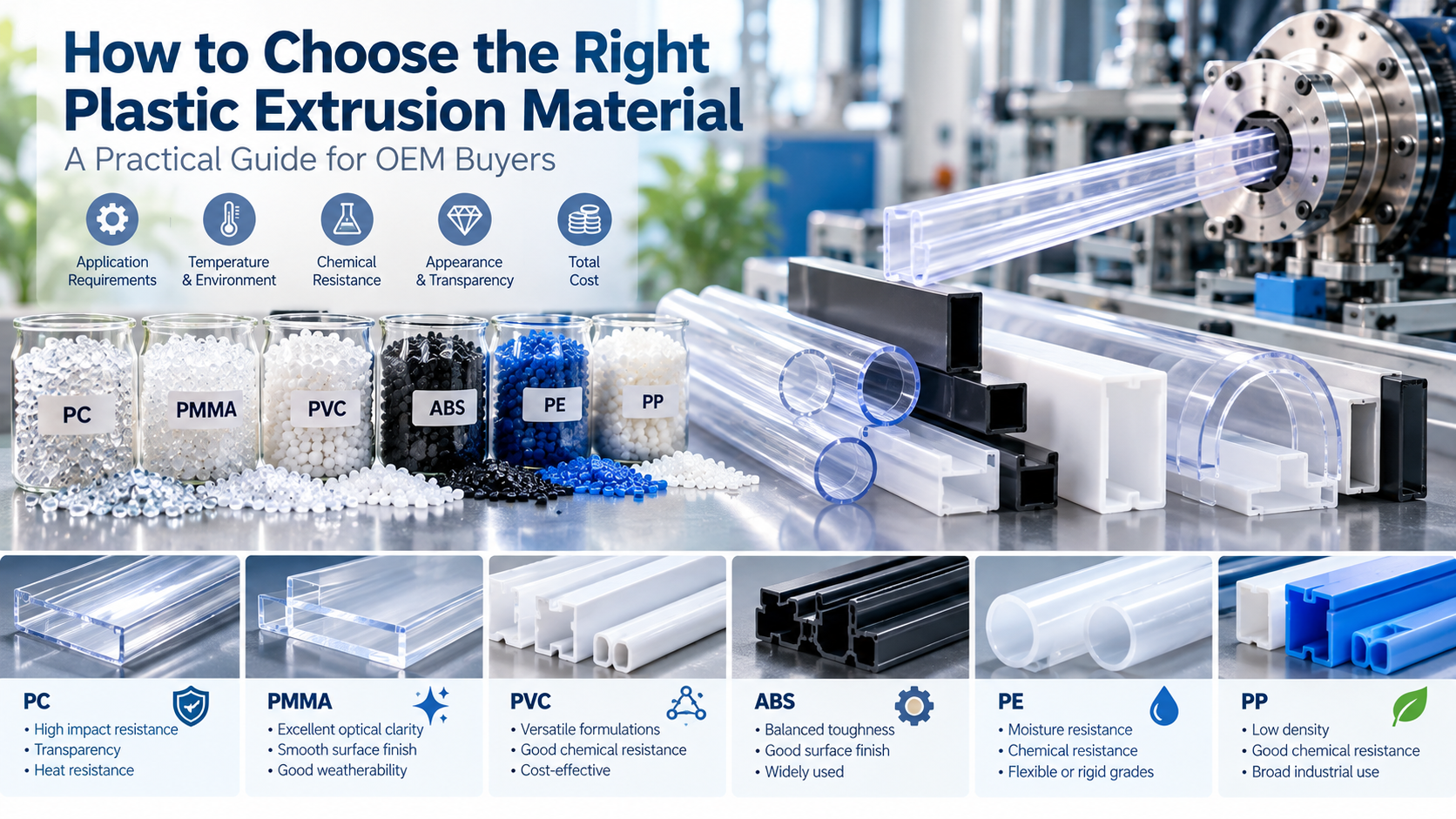
How to Choose the Right Plastic Extrusion Material: A Practical Guide for OEM Buyers
Choosing the Right Material Is Not About Finding the Strongest Plastic. It Is About Finding the Right Balance.
Imagine you are developing a transparent protective cover for industrial equipment. Your design team wants excellent clarity, your engineers need reliable impact resistance, and your purchasing department wants to keep costs under control.
Which plastic should you choose?
Polycarbonate (PC) may be a strong candidate because of its impact resistance. Acrylic (PMMA) may be attractive when optical clarity and surface appearance are priorities. Other materials may be suitable if the application has different performance requirements.
The answer depends on what the finished product must do—not simply which material has the best reputation.
For OEM manufacturers, product designers, and industrial buyers, selecting the right plastic extrusion material is one of the most important decisions in a custom manufacturing project. The wrong choice can create unnecessary costs, processing difficulties, dimensional problems, or premature product failure.
In this guide, LEZPC explains how to evaluate plastic extrusion materials, compare common thermoplastics, and make a more informed decision before committing to tooling and mass production.
1. Start With the Application, Not the Material Name
One of the most common mistakes in material selection is choosing a polymer before defining the product's operating requirements.
Instead, start with five practical questions.
What Will the Product Need to Withstand?
Will the extruded component experience repeated impacts, continuous mechanical loads, vibration, bending, or abrasion?
A protective cover may require impact resistance, while a decorative profile may prioritize surface appearance and dimensional consistency. A sliding component may need suitable friction and wear characteristics.
These requirements can point toward very different material choices.
Will the Product Be Used Indoors or Outdoors?
Outdoor exposure introduces additional considerations, including ultraviolet (UV) radiation, temperature fluctuations, moisture, and weathering.
Two materials that perform similarly indoors may behave differently after prolonged outdoor exposure.
Where appearance and long-term weatherability matter, evaluate the specific resin grade and any UV-resistant additives or protective coatings. Do not assume that every grade within a polymer family provides the same outdoor performance.
Does Transparency Matter?
For lighting diffusers, transparent tubes, display components, and protective windows, optical properties may be as important as mechanical performance.
Questions to consider include:
-
How much light transmission is required?
-
Is low haze important?
-
Must the product maintain a consistent appearance over time?
-
Will the component be exposed to heat, UV radiation, or cleaning chemicals?
A transparent material that looks excellent in a sample may not be suitable if the finished product cannot meet its optical or environmental requirements.
What Temperatures and Chemicals Will the Product Encounter?
Consider both the normal operating temperature and the maximum temperature the component may experience.
Also identify potential exposure to oils, cleaning agents, solvents, detergents, fuels, or other chemicals.
Chemical compatibility depends on the exact chemical, concentration, temperature, exposure duration, material grade, and mechanical stress. When the application is critical, request compatibility data and conduct appropriate testing.
What Is the Total Project Budget?
The lowest resin price does not necessarily produce the lowest finished-part cost.
Material selection can influence extrusion stability, cooling time, dimensional control, scrap rates, tooling requirements, inspection costs, and product service life.
The more useful question is:
Which material meets the required performance at the lowest acceptable total cost?
2. Compare Six Common Plastic Extrusion Materials
Different polymers offer different combinations of optical performance, mechanical properties, chemical resistance, processing characteristics, and cost.
The following comparison is a starting point for selecting candidate materials. Actual performance varies by grade and formulation.
| Material | Main advantages | Important considerations | Typical applications |
|---|---|---|---|
| Polycarbonate (PC) | High impact resistance, transparency, useful heat resistance | Chemical compatibility, UV exposure, and grade selection require attention | Protective covers, industrial tubes, lighting components |
| Acrylic (PMMA) | Excellent optical clarity, attractive surface appearance, good weatherability in suitable grades | Generally more brittle than PC under impact | Display components, light guides, decorative profiles |
| Polyvinyl Chloride (PVC) | Available in rigid and flexible formulations, useful chemical resistance in suitable grades | Formulation and thermal processing require control | Construction profiles, channels, protective edging |
| Acrylonitrile Butadiene Styrene (ABS) | Balanced toughness, rigidity, and surface finish | Outdoor weatherability and chemical exposure depend on grade | Equipment housings, interior profiles, functional components |
| Polyethylene (PE) | Good moisture resistance and chemical resistance in many environments | Stiffness, temperature limits, and dimensional behavior vary by grade | Tubes, protective components, industrial profiles |
| Polypropylene (PP) | Low density, useful chemical resistance, and broad industrial applicability | Low-temperature impact, shrinkage, and stiffness must be evaluated | Industrial components, channels, tubing, functional profiles |
This table is intended for preliminary screening, not as a substitute for engineering evaluation.
Polycarbonate (PC): When Impact Resistance Matters
Polycarbonate is often considered when a product needs transparency combined with substantial impact resistance.
Potential applications include protective covers, industrial equipment components, lighting-related products, and customized extruded tubes or profiles.
However, transparent PC is not automatically the best choice for every optical application. Chemical exposure, stress cracking, UV stability, surface requirements, and operating temperature should all be evaluated.
Consider PC when: Impact resistance is a major requirement and the selected grade can satisfy the application's optical, thermal, and environmental conditions.
Acrylic (PMMA): When Appearance and Optical Clarity Lead
Acrylic is frequently considered for products where clear appearance, light transmission, and surface quality are important.
It can be suitable for display components, lighting applications, and decorative profiles. Depending on the grade and application, it may also provide good outdoor weatherability.
Its main trade-off is impact performance: acrylic is generally more brittle than polycarbonate.
Consider PMMA when: Optical clarity and appearance are high priorities and the expected impact loads are manageable.
PVC: When Versatility and Cost Control Matter
PVC is available in rigid and flexible formulations, giving manufacturers considerable flexibility when developing different types of extruded profiles.
Rigid PVC may be suitable for channels, trims, and construction-related components. Flexible PVC can be considered for certain protective edges, seals, and profiles requiring flexibility.
The formulation matters. Plasticizers, stabilizers, pigments, and other additives influence the finished product's performance and processing behavior.
Consider PVC when: The application benefits from its formulation flexibility, practical performance, and cost characteristics, provided the specific grade meets the service requirements.
ABS: When Balanced Mechanical Performance Is Needed
ABS is used in many functional and appearance-sensitive components because it can offer a useful balance of rigidity, toughness, and surface finish.
It may be appropriate for equipment profiles, interior components, and customized structural or decorative sections.
However, outdoor applications require particular attention to UV resistance and weathering performance.
Consider ABS when: The design needs a balance of stiffness, toughness, appearance, and manufacturing practicality.
PE: When Chemical and Moisture Resistance Matter
Polyethylene is available in multiple grades, including LDPE and HDPE, with different mechanical and processing characteristics.
Depending on the grade, PE can provide useful moisture resistance, chemical resistance, and flexibility or stiffness.
Material creep, operating temperature, dimensional requirements, and the intended chemical environment should be assessed before selecting a grade.
Consider PE when: The application benefits from moisture resistance, chemical resistance, or particular flexibility and toughness characteristics.
PP: When Low Density and Chemical Resistance Are Important
Polypropylene is widely used in industrial applications where low density and resistance to many chemicals are desirable.
It can be considered for functional profiles, tubes, and other extruded components. However, temperature conditions, impact requirements, shrinkage, and dimensional stability must be evaluated.
Consider PP when: Low density and chemical resistance align with the application, and the selected grade meets the required mechanical and dimensional specifications.
3. Match the Material to the Real Application
A material comparison becomes much more useful when it is connected to an actual product requirement.
Consider the following examples.
Scenario A: A Transparent Industrial Protective Cover
Primary requirements: Transparency, impact resistance, dimensional consistency, and reliable service performance.
Materials to evaluate: PC and PMMA.
PC may be a logical starting point when impact resistance is critical. PMMA may be attractive when optical appearance is the main priority and impact exposure is limited.
The final decision should consider optical specifications, environmental exposure, cleaning chemicals, and the component's geometry.
Scenario B: A Custom Profile for Indoor Equipment
Primary requirements: Dimensional accuracy, rigidity, appearance, and cost control.
Materials to evaluate: ABS, rigid PVC, or another suitable thermoplastic.
The best choice depends on the profile's structural function, temperature exposure, surface requirements, and manufacturing constraints.
Scenario C: A Flexible Protective Edge
Primary requirements: Flexibility, recovery, fit, and resistance to the expected environment.
Materials to evaluate: Flexible PVC or a suitable thermoplastic elastomer (TPE).
The required hardness, compression behavior, temperature range, and chemical exposure should be defined before choosing the formulation.
Scenario D: A Tube Used in a Chemical Environment
Primary requirements: Chemical compatibility, pressure or mechanical requirements, temperature resistance, and dimensional stability.
Materials to evaluate: A suitable PE, PP, PVC, or other polymer selected according to the specific service conditions.
Do not select a material based only on a general statement that it is chemically resistant. Verify compatibility with the actual chemical, concentration, temperature, and expected service life.
These scenarios illustrate an important principle: material selection should follow the application's critical requirements rather than a generic ranking of plastics.
4. The Hidden Factor: Can the Material Be Extruded Reliably?
A material may have attractive laboratory properties but still be difficult to process into a particular custom profile.
Plastic extrusion involves melting or softening a thermoplastic, conveying it through a die, and controlling the shape as the material cools.
The selected material influences several manufacturing considerations.
Melt Flow and Process Stability
The resin's rheological properties affect how it flows through the extrusion system and die.
A suitable material grade must be compatible with the required profile geometry, equipment, and processing conditions.
Cooling and Dimensional Stability
Extruded plastics change dimensions as they cool. The degree and nature of dimensional change depend on the material, geometry, processing conditions, and cooling method.
Thin walls, asymmetric profiles, hollow sections, and tight tolerances may require additional process development.
Die Design and Profile Geometry
Not every material behaves the same way when passing through a die.
A change in polymer or grade can affect flow distribution, die swell, shrinkage, surface appearance, and the stability of the finished profile.
This is why material substitution should not be treated as a simple purchasing decision. A replacement material may require engineering review, process adjustments, and new sample validation.
Production Consistency
For OEM projects, the goal is not merely to produce one acceptable sample. The material and process must work together to achieve repeatable results across production batches.
A supplier should therefore evaluate material selection alongside tooling feasibility, dimensional tolerances, inspection methods, and production requirements.
5. Do Not Compare Materials by Resin Price Alone
A low-cost material may appear attractive at the quotation stage, but the financial impact of a material choice extends beyond the price per kilogram.
Consider a simplified project cost model:
Total project cost = Material + Tooling + Processing + Quality control + Scrap and rework + Logistics
This is a planning framework rather than a universal accounting formula; the exact cost categories depend on the project.
A more expensive resin may be justified when it is necessary to meet performance requirements or improve product reliability. Conversely, a premium engineering plastic may add unnecessary cost if a more economical material can satisfy all the specified requirements.
Before finalizing a material, ask your manufacturer to clarify:
-
Whether the selected grade meets the critical specifications.
-
Whether the profile can be extruded consistently.
-
Whether the tooling design is appropriate for the chosen material.
-
Whether additional testing or inspection is required.
-
Whether the proposed material can be supplied consistently.
-
Whether an alternative grade could meet the same requirements at a lower total cost.
The goal is not to buy the most expensive plastic or the cheapest plastic. It is to make a technically sound and commercially sensible decision.
6. A Practical Material Selection Checklist for OEM Buyers
Before requesting a quotation for custom plastic extrusion, prepare the following information.
1. Product application
Explain what the component does, where it will be installed, and what it must withstand.
2. Material preferences
Identify any preferred polymers, existing material specifications, or known requirements. If the material is undecided, ask the manufacturer to recommend suitable candidates.
3. Technical drawings
Provide the cross-sectional drawing, critical dimensions, wall thicknesses, and required tolerances.
4. Environmental conditions
Specify operating temperature, UV exposure, humidity, chemical contact, and any relevant mechanical loads.
5. Appearance requirements
Clarify transparency, color, surface finish, texture, and any visual acceptance criteria.
6. Compliance requirements
Identify any applicable customer specifications or regulatory requirements. Food-contact, medical, electrical, flame-retardant, and other regulated applications may require specific grades, evidence, or certifications.
7. Order quantity and delivery expectations
Provide estimated sample quantities, annual demand, target production volumes, and delivery requirements.
8. Validation and quality control
Define the tests, sample approvals, dimensional measurements, and inspection records needed before mass production.
The more clearly these requirements are defined, the easier it becomes to narrow the material options and assess manufacturing feasibility.
7. Why Early Collaboration With Your Extrusion Manufacturer Matters
Material selection should not happen in isolation from product design and manufacturing.
An experienced extrusion partner can help review the application, compare potential materials, identify design risks, and determine whether a proposed profile is suitable for the intended process.
For example, a minor adjustment to wall thickness or cross-sectional geometry may make a profile easier to manufacture while maintaining its required function. In other cases, the original material choice may be essential and should not be changed without proper testing.
Early technical discussions can help identify these issues before tooling investment and mass production.
At LEZPC, the starting point for a custom plastic extrusion project should be a clear understanding of the product, the material requirements, the target dimensions, and the intended application.
Whether you are developing transparent components, customized plastic tubes, protective profiles, or other extruded products, the appropriate solution depends on the specific project requirements.
Conclusion: Choose the Material That Fits the Project
There is no single plastic extrusion material that is best for every application.
Polycarbonate may be a strong candidate for impact-resistant transparent components. Acrylic may be suitable when optical appearance is a priority. PVC, ABS, PE, PP, and other thermoplastics each offer different combinations of properties and trade-offs.
The most reliable approach is to define the application's critical requirements, compare suitable material grades, assess extrusion feasibility, and validate the finished product before committing to full production.
Need help selecting a material for your next project?
Share your product drawing, intended application, operating conditions, target dimensions, and estimated order quantity with LEZPC.
Our team can review your requirements and help you explore suitable material and custom plastic extrusion options.
Contact LEZPC to discuss your project and request a quotation.
Table of Contents
- 1. Start With the Application, Not the Material Name
-
2. Compare Six Common Plastic Extrusion Materials
- Polycarbonate (PC): When Impact Resistance Matters
- Acrylic (PMMA): When Appearance and Optical Clarity Lead
- PVC: When Versatility and Cost Control Matter
- ABS: When Balanced Mechanical Performance Is Needed
- PE: When Chemical and Moisture Resistance Matter
- PP: When Low Density and Chemical Resistance Are Important
- 3. Match the Material to the Real Application
- 4. The Hidden Factor: Can the Material Be Extruded Reliably?
- 5. Do Not Compare Materials by Resin Price Alone
- 6. A Practical Material Selection Checklist for OEM Buyers
- 7. Why Early Collaboration With Your Extrusion Manufacturer Matters
- Conclusion: Choose the Material That Fits the Project