 EN

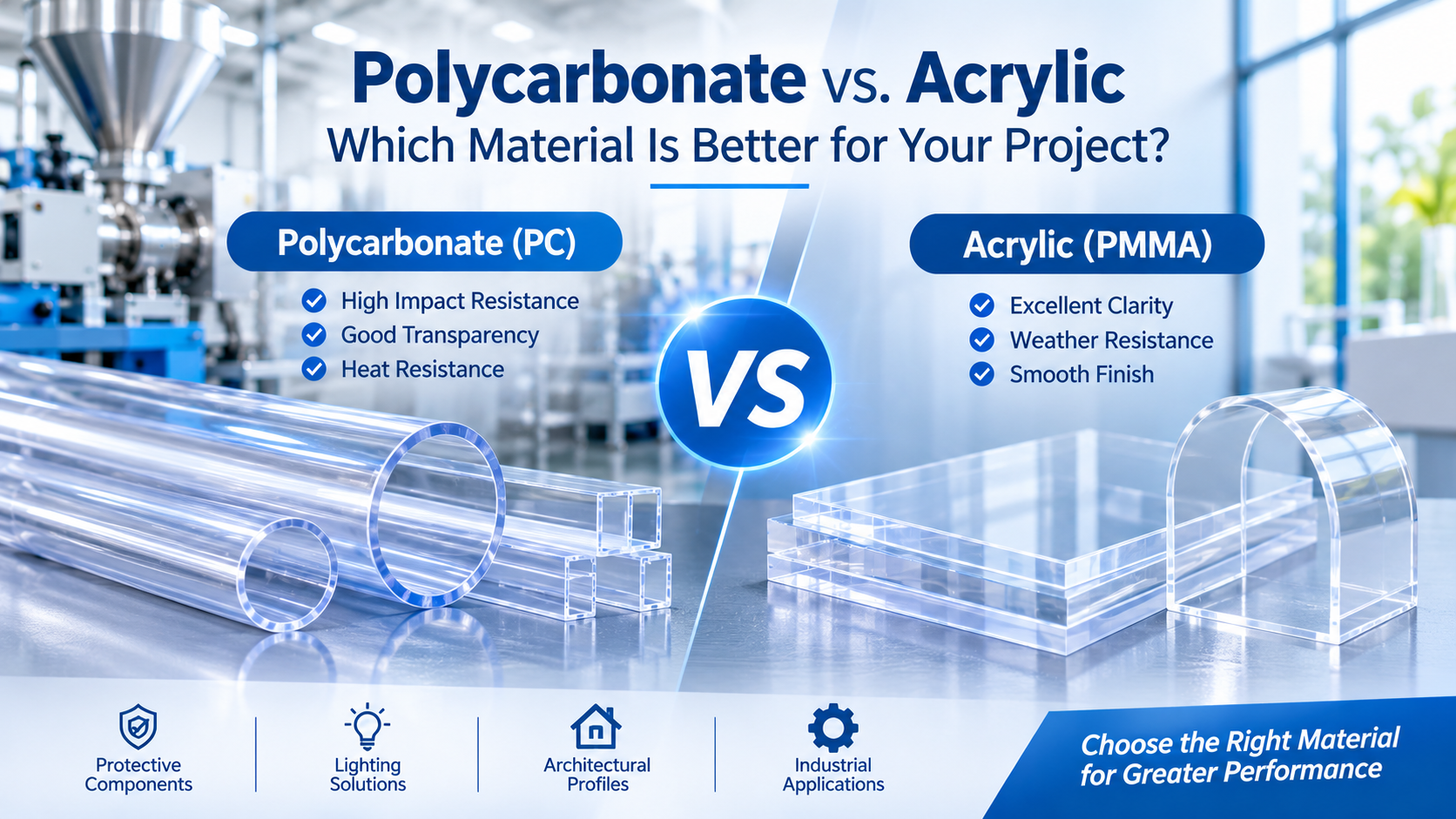
Polycarbonate vs. Acrylic: Which Material Is Better for Your Project?
When choosing a transparent plastic material for an industrial or commercial project, two options often come up: Polycarbonate (PC) and Acrylic (PMMA).
Both materials offer excellent transparency and are widely used in plastic products, lighting components, protective covers, and custom extruded profiles. However, they have different performance characteristics.
So, which one is better for your project?
The answer depends on what matters most: impact resistance, optical clarity, surface appearance, outdoor performance, or manufacturing cost.
In this guide, LEZPC compares PC and PMMA to help OEM buyers, engineers, and product designers make a more informed material decision.
1. Polycarbonate vs. Acrylic: Key Differences
Although PC and PMMA may look similar, their properties are quite different.
| Property | Polycarbonate (PC) | Acrylic (PMMA) |
|---|---|---|
| Transparency | Excellent | Excellent, generally clearer |
| Impact resistance | Very high | Lower, more brittle |
| Surface hardness | Relatively softer | Harder |
| Scratch resistance | Lower without coating | Generally better |
| Weather resistance | Depends on UV-stabilized grade or coating | Generally very good |
| Heat resistance | Generally higher | Generally lower |
| Typical material cost | Often higher | Often lower |
Note: These are general material comparisons. Actual performance depends on the resin grade, additives, product design, and operating conditions.
2. When Should You Choose Polycarbonate (PC)?
Polycarbonate is an excellent candidate when impact resistance and mechanical toughness are important.
Its key advantages include:
-
High impact resistance: Suitable for components exposed to accidental impacts and mechanical stress.
-
Good transparency: Allows light transmission while providing greater toughness than many other transparent plastics.
-
Heat resistance: Often suitable for applications involving higher operating temperatures than standard acrylic grades.
-
Design flexibility: Can be processed into customized tubes and profiles when the resin grade and extrusion conditions are properly selected.
Common applications:
-
Industrial protective covers
-
Machine safety guards
-
Transparent protective tubes
-
Lighting components
-
Customized industrial profiles
If your product needs to withstand impact while maintaining transparency, PC is worth considering.
For outdoor applications, specify a suitable UV-stabilized or UV-protected grade.
3. When Should You Choose Acrylic (PMMA)?
Acrylic is often preferred when optical clarity, surface appearance, and weatherability are the main priorities.
Its advantages include:
-
Excellent optical clarity: Ideal for applications requiring a clean, transparent appearance.
-
Better surface hardness: Generally offers better scratch resistance than uncoated standard polycarbonate.
-
Good weatherability: Suitable grades perform well in many outdoor applications.
-
Attractive finish: Often selected for decorative and light-transmitting components.
Common applications:
-
Lighting diffuser components
-
Display profiles
-
Transparent decorative tubes
-
Optical components
-
Signage and display products
If appearance and optical performance are more important than high impact resistance, PMMA may be the better option.
4. PC or PMMA: Which Is Better for Plastic Extrusion?
For custom plastic extrusion projects, material performance is only part of the decision.
Manufacturing feasibility also matters.
PC and PMMA have different processing characteristics, and both require appropriate temperature control, material preparation, die design, and cooling conditions.
For example:
-
Transparent tubes: Consider PC when impact resistance is critical; consider PMMA when optical appearance is the priority.
-
Lighting diffuser profiles: PMMA may be suitable when clarity and light transmission are essential, while PC may be preferred where impact resistance is also required.
-
Protective industrial profiles: PC is often a strong candidate for demanding impact conditions.
-
Decorative profiles: PMMA may offer advantages in surface appearance and optical quality.
Before mass production, it is important to evaluate sample quality, dimensional tolerances, surface finish, and actual application performance.
5. How to Make the Right Material Decision
Before selecting PC or PMMA, ask yourself five questions:
-
Does the product need high impact resistance?
-
Is maximum optical clarity a priority?
-
Will it be exposed to sunlight or outdoor conditions?
-
What operating temperature and chemical exposure should it withstand?
-
What is the acceptable balance between material cost and product performance?
Answering these questions will help narrow down the options.
If the application has strict requirements, request the technical datasheets for the specific material grades and validate them through sample testing.
6. Looking for a Custom Plastic Extrusion Solution?
Choosing the right material is the first step toward a successful extrusion project. The next step is finding a manufacturing partner who understands material properties, tooling design, dimensional requirements, and production quality.
At Lianzhen, we focus on customized plastic extrusion products for different industrial and commercial applications.
Whether you need polycarbonate tubes, acrylic profiles, transparent components, or customized plastic extrusion solutions, our team can help evaluate your project requirements and explore suitable manufacturing options.
Not sure whether PC or PMMA is right for your project?
Send us your product drawing, dimensions, application details, and estimated order quantity.
Contact us to discuss your requirements and request a custom extrusion quotation.
Better material selection starts with a better understanding of your application.