 EN

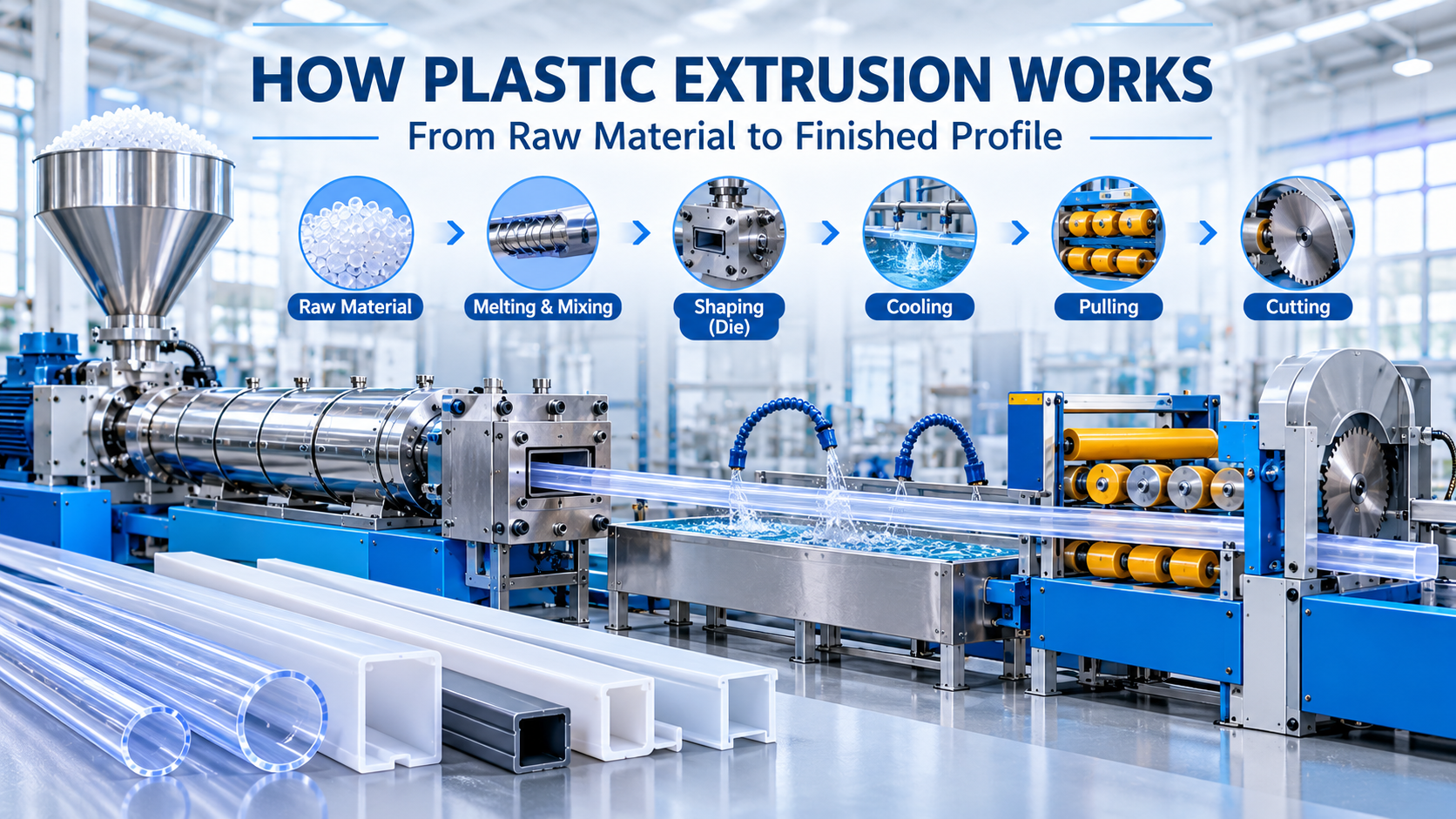
How Plastic Extrusion Works: From Raw Material to Finished Profile
Plastic extrusion is one of the most widely used manufacturing processes for producing continuous plastic products with a consistent cross-section. From transparent tubes and protective channels to custom industrial profiles, extrusion turns raw plastic materials into practical components for a wide range of industries.
But how does the process actually work? What happens between a bag of plastic pellets and a finished profile?
Let's take a closer look at the key stages of plastic extrusion and the factors that influence product quality.
1. Raw Material Selection and Preparation
Every successful extrusion project starts with the right raw material.
Common thermoplastics used in extrusion include:
-
PVC: Suitable for building profiles, cable channels, and protective components.
-
PE: Commonly used for tubing, pipes, and flexible applications.
-
PP: Offers a useful balance of chemical resistance, lightweight properties, and cost.
-
ABS: Often selected for its rigidity, impact performance, and surface appearance.
-
PC: Suitable for applications requiring high impact resistance and transparency.
-
PMMA (Acrylic): Known for excellent optical clarity and weatherability.
Depending on the product requirements, manufacturers may also add colorants, UV stabilizers, impact modifiers, or other additives.
Some materials, particularly moisture-sensitive engineering plastics, require drying before processing. Proper material preparation helps reduce defects and supports more consistent production.
2. Feeding, Melting and Plasticizing
Prepared plastic pellets are transferred into the extruder through a feed hopper.
Inside the heated barrel, a rotating screw moves the material forward. Heat from the barrel heaters, together with mechanical energy generated by screw rotation, gradually softens and melts the plastic.
The screw also helps mix and homogenize the material, creating a consistent melt before it reaches the die.
Temperature, screw speed, and material flow must be carefully controlled. Incorrect processing conditions can contribute to problems such as bubbles, discoloration, uneven surfaces, or inconsistent dimensions.
3. Shaping Through a Custom Extrusion Die
Once the plastic reaches a suitable molten condition, it is pushed through a specially designed extrusion die.
The die determines the basic cross-sectional shape of the product. Depending on the design, the output may be:
-
Plastic tubes and pipes
-
U-shaped, T-shaped, and L-shaped profiles
-
Protective covers and edge trims
-
Plastic channels and structural components
-
Custom profiles for lighting, furniture, and industrial equipment
For custom extrusion projects, die design is especially important. Wall thickness, internal cavities, corner geometry, and material flow all need to be considered.
A well-designed die helps achieve a consistent profile and reduces the need for extensive downstream correction.
4. Calibration and Cooling
The plastic leaving the die is still hot and needs to be cooled while maintaining its intended shape.
Depending on the product, the production line may use vacuum calibration, water tanks, spray cooling, or air cooling.
For many custom profiles and tubes, calibration equipment helps control critical dimensions such as outside diameter, wall thickness, and overall geometry.
Cooling must be balanced. If the product cools unevenly or too quickly, it may develop warping, shrinkage, internal stress, or dimensional variation.
5. Haul-Off, Cutting and Finishing
After cooling and stabilization, a haul-off unit pulls the continuous profile through the production line at a controlled speed.
The relationship between extrusion output and haul-off speed affects the final dimensions. Consistent pulling is therefore important for maintaining product uniformity.
The product is then processed according to its application. Typical finishing operations include:
-
Cutting to specified lengths
-
Trimming edges
-
Drilling or punching
-
Surface treatment or printing
-
Inspection, sorting, and packaging
Some products are cut into individual pieces, while flexible tubing or other continuous products may be wound into coils.
6. Quality Inspection: Turning a Profile into a Reliable Product
A finished profile should meet the agreed specifications, not simply look correct.
Common quality checks include:
-
Dimensional accuracy: Checking width, height, wall thickness, and other critical measurements.
-
Surface appearance: Inspecting for scratches, bubbles, discoloration, and flow marks.
-
Material performance: Confirming that the selected material meets the required strength, flexibility, transparency, or chemical resistance.
-
Consistency: Comparing samples from different production stages or batches.
For OEM projects, it is helpful to confirm drawings, material grades, tolerances, color requirements, and inspection criteria before mass production begins.
What Determines the Quality of a Plastic Extruded Profile?
The final result depends on more than the extrusion machine itself. Several factors work together:
-
Material selection: The resin must match the product's operating environment and performance requirements.
-
Die design: The die must support balanced material flow and the required cross-section.
-
Process control: Temperature, screw speed, pressure, and output need to be properly managed.
-
Cooling and calibration: These stages help maintain dimensional stability and product shape.
-
Quality inspection: Consistent measurement and process monitoring help identify issues early.
A problem at one stage can affect the final product, which is why successful extrusion requires coordination across the entire production line.
From Custom Design to Finished Plastic Extrusion
Plastic extrusion offers an efficient way to manufacture continuous products with customized cross-sections. It is widely used in construction, lighting, electronics, furniture, automotive components, and industrial equipment.
For buyers developing a new extrusion project, preparing a technical drawing, selecting the right material, and defining dimensional requirements are important first steps.
Looking for a custom plastic extrusion solution?
LEZPC works with customers on plastic extrusion products based on project drawings, material requirements, dimensions, colors, and application needs.
Contact our team to discuss your project and explore a suitable manufacturing solution.
Table of Contents
- 1. Raw Material Selection and Preparation
- 2. Feeding, Melting and Plasticizing
- 3. Shaping Through a Custom Extrusion Die
- 4. Calibration and Cooling
- 5. Haul-Off, Cutting and Finishing
- 6. Quality Inspection: Turning a Profile into a Reliable Product
- What Determines the Quality of a Plastic Extruded Profile?
- From Custom Design to Finished Plastic Extrusion